Water Disposal Compliance
At Sparkling Bins, we’re committed to protecting the environment while providing the highest level of sanitation equipment and service. If you clean trash and recycling bins it’s essential to understand the rules around wastewater, or “wash water,” disposal.
Are Sparkling Bins Systems EPA Compliant?
It’s a fair question, and the honest answer has two parts. Sparkling Bins systems are designed from the ground up to support environmentally compliant bin-cleaning operations — capturing, containing, and transporting the wash water generated during cleaning so it isn’t discharged onto streets, into storm drains, or onto surrounding property. But compliance also depends on the operator: once wash water is captured, it must still be properly managed and disposed of at an approved location. In other words, capturing the water is step one; proper disposal, with local approval, is step two.
So when you compare systems and hear the term “EPA compliant,” we encourage you to ask two simple questions:
- Does the system capture the wash water?
- What happens to that wash water afterward?
Our equipment is built around the first question, and we help every client understand their responsibility for the second. For the full explanation including what a widely cited state inspection letter actually says about water-reuse systems —
How Our Cleaning Process Captures & Contains Wash Water
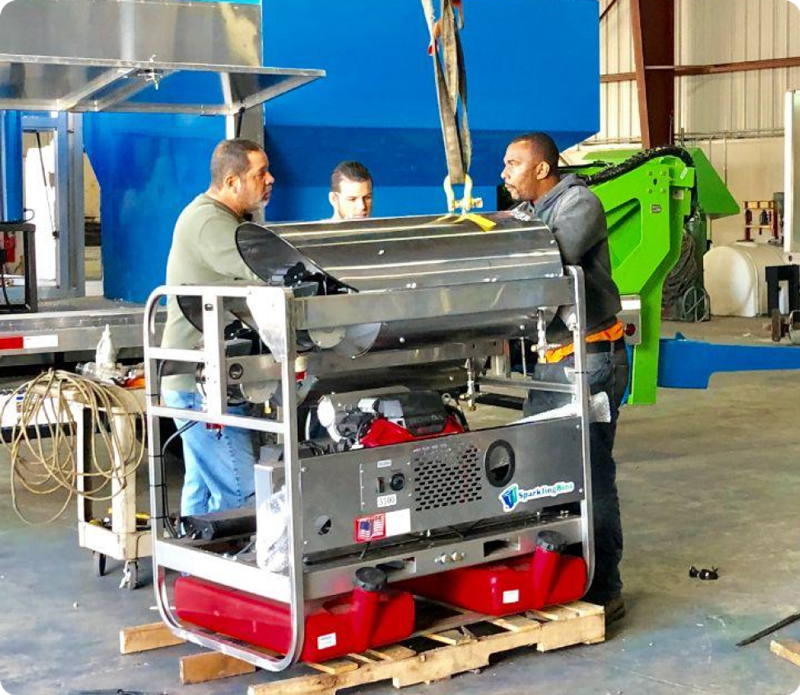
Sparkling Bins equipment is engineered to keep wash water contained from the moment it’s collected until it reaches an approved disposal location. Our patented equipment is designed around responsible capture and containment the foundation of compliant, real-world operation.

Our cleaning hoppers use a closed-top design that keeps wash water contained while the vehicle operates or travels on public roads — reducing the potential for spills, leaks, or discharge.

A catch tray built into the hopper captures debris and solid waste from the bin so it never enters the wash water holding tank, keeping solids separated for proper disposal.

The system captures and holds all wash water generated during cleaning rather than allowing it to reach streets, storm drains, or surrounding property.

We clean each customer’s bins with fresh, potable water rather than filtering and recirculating the same water from bin to bin — the more sanitary approach, with fewer components to maintain.

We use approximately 200°F hot water, which sanitizes and disinfects bins by eliminating many germs, bacteria, and viruses.

All cleaning products supplied by Sparkling Bins are biodegradable and environmentally friendly.
Wash Water Disposal
Frequently Asked Questions
Are Sparkling Bins systems EPA compliant?
Our systems are designed to support environmentally compliant operations — they capture, contain, and transport wash water so it isn’t discharged to streets or storm drains. Full compliance also depends on the operator properly disposing of that captured water at an approved location with local written approval.
Do you recycle or filter the wash water?
No. We clean each customer’s bins with fresh, potable water rather than filtering and recirculating the same water from bin to bin. It’s the more sanitary approach and means fewer components to maintain; used wash water is captured and contained for proper disposal.
Can I pour bin cleaning gray water down a storm drain?
No. Under the Clean Water Act, only rainwater should enter a storm drain. Gray water from bin cleaning must be collected and disposed of at an approved facility.
Where can I legally dispose of gray water from trash bin cleaning?
Depending on local rules, approved options include sanitary-sewer-connected car washes (with a grease trap and permission), RV dump stations, truck stops with waste-disposal facilities, and municipal or county wastewater treatment plants.
Do I still need to dispose of gray water at an approved site if I recycle or filter it?
Yes. Recycled or filtered gray water is subject to the same disposal requirements as untreated gray water and must go to an approved location.
Who enforces gray water disposal rules?
The EPA sets federal guidance, but cities and counties enforce the rules locally, so requirements vary by jurisdiction. Always confirm with your local environmental or public works department.
How does Sparkling Bins equipment prevent water pollution?
Our systems capture all wastewater in a collection tray, separate solids with a filtered catch tray before storage, use approximately 200°F water for sanitation, and pair with biodegradable cleaning products.
Ready to Start?
Let’s Build Your Business Together.
Talk with our team to get pricing, timelines, and answers to all your questions.